Cari Blog Ini

Tampilkan postingan dengan label Lisa Bent. Tampilkan semua postingan

Sabtu, 20 April 2013

I'mPOSSIBLE: Youth Edition at The House of Commons


Hot on the heels of the March 8, international women’s day edition that took place at the revered Royal Festival Hall as part of Southbank’s annual Women of the World festival,I’mPOSSIBLE  is back with a special youth edition as part of ‘Take Our Daughters and Sons to Work Day’ activities. The venue for this edition will be at The House of Commons in partnership with Black Women Mean Business’ (BWMB), founded by Diane Abbott MP  in 1992 as a non-profit, non-aligned initiative. BWMB is concerned with supporting and celebrating black women professionals, black businesswomen and with black entrepreneurship generally, so in in line with I’mPOSSIBLE.
The youth edition, is made up of five female panellists who found success (and are still building on it) during their teens or early twenties.  The audience for the event will be made up of young girls between 14-18 years from a selection of London schools and youth projects, whilst the panel consists of young women below the age of 30 who many found success in their teens or early twenties. The panellists for this edition consist of: Sheila Nortley – Filmmaker,  Kingdom Entertainment Group,  Celeste Houlker – editor, Live Magazine,Barbara Kasumu – Elevation Networks, Sheryl Nwosu – Barrister and Sarah Tetteh -journalist, Huffington Post and I am very happy and honoured to be the host.
I’mPOSSIBLE founder Simone Bresi-Ando is certainly making her mark in her bid to inspire Women of Colour she said…
“2013 is already shaping up to be a momentous year for I’mPOSSIBLE!  The fact our events are being hosted in places like the Royal Festival Hall and now the House of Commons is indicative of the essential work the social enterprise is doing to empower women and young girls everywhere.”  
 “We are presenting role models that don’t always get the recognition they deserve but are leaving a trailblazing legacy for a new generation to stand on their shoulders and build higher. Having a youth edition of the  I’mPOSSIBLE conversation is a long standing dream which I’m now seeing fulfilled.  The next step is to make this a continuing occurrence which reaches as many young girls as possible.”

This event is going to be amazing and the first of many more to come. Keep up to date with ImPOSSIBLE: www.i-am-possible.com  
Follow on Twitter:@IAMPOSSIBL3
Read a past review at Endless Possibilities 
© Lisa Bent 2013

Selasa, 04 Oktober 2011

Dot to Dot: Part 2

Black is...
Slavery was...
I am....
I was hesitate as I walked up the steps and into the International Slavery Museum. A mixture of dread and expectancy of the horrors that I was about to face, I know was the cause.  The sound of noisy school children broke my anxiety and replaced it with annoyance. My purpose for visiting the museum as explained in  Dot to Dot:Part 1, was to look at my historical past and so in a strange way it was almost like I was visiting the graves of my ancestors and this space was my moment to gather and process through quiet reflection which was now trampled on by carelessness, naivety and a lack of respect. It was difficult but I soon zoned the disruptions out and dropped the strong sense of seriousness that I was clearly carrying.
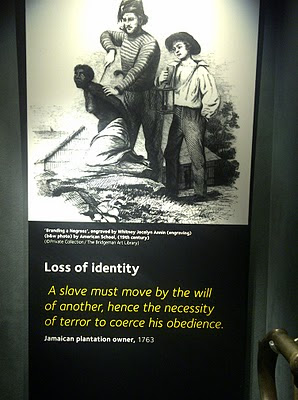
The dimly lit room quickly set the mood, heavy, thick, dense and oppressive. Each step was greeted with voices of the past through quotes carved into the walls. This one in particular stood out for me
How insightful? How true? How sad! I have only ever focused on their pain overlooking their courage.

The museum holds a wealth of information stemming from and explaining...
  • How Slavery began
  • The middle passage voyages
  • How slaves were treated
  • Who profited and the economic benefits of slavery
  • The impact of Africa
  • Global inequality and contemporary slavery
  • From the shores of Africa the influence of black music today
  • Exploration from various voices as to what it means to be Black British, African-American or of African decent in different parts of the world today. 
The photographs I am about to include are based on what resonated most with me, coupled with brief comments before expressing further thoughts and insights. 

My mouth hung open for sometime before making a few comparisons that are thoughts and questions  and ones that probably will remain that way.


If cellular memory exits and black people as  a collective have internalised Oppression than there must be an opposite for white people. I have heard of white privilege and white guilt but is there more within their unconsciousness? What is the conditioned behaviour and how would this be displayed due to their historical past in the present?
                                            
This weekend a friend posted to me Michael Moore's A brief history of The United States 
Interesting right? 


I cannot and will never be able to fully imagine what it must have felt like to be shackled.These shackles are from the Late 18th Century and were found in Tamale, Northern Ghana.


"Africans were branded with hot irons, no differently from cattle to mark them out as possessions.Plantation owners and slave traders alike justified their atrocious actions by claiming that black men, women and children were closer to animals than they were to white people." 

In regards to the branding of slaves, I have always wondered whether this has informed my dislike for tattoos. Perhaps I  simply just don't like them. 
"Sold, branded and issued with a new name, the enslaved Africans were separated and stripped of their identity". 

In the picture below you can see that their names had been replaced with English sounding names. On the fourth line down a man was given the name "Nobody". 
The sensory room is interestingly powerful. The sound of the waves and the quick glimpses of shackles and vomit successfully  conjure up the severe confined space, restriction and confusion. As I'm in there I remember the time I was sick on the ferry on the way to France. At the time I thought I was dying and just wanted the whole experience to end. Even if I multiply my encounter by 1000 I would still be no where near in successfully recreating the experience on a slave ship.


“A churnel stench, effluvium of loving death spreads outward form the hold, where the living and the dead, the horribly dying, lie interlocked, lie foul with blood and excrement”.  Robert Hayden, 1962
I sat in another room and listened to an African women tell the heart rending story of her children being captured and enslaved. This was the first time that I fully acknowledged the two way process of loss. Children and adults were removed from their families by force and entered into the unknown. The people left behind also entered into the same grieving process and uncertainty. The level of trauma to both sides is immeasurable and further heightened when friends, siblings and relatives who were taken together were sold and separated.  

As the risk of being taken was high, many equipped their children with knowledge in how to best survive. This makes sense but can you imagine the level of anxiety this must have caused in both the parent and child? They were prepared from an early age and I now see the residue from the past and into the future with “Your black and you have to work ten times harder than your white counterparts”. The line between preparation and conditioning appears to have merged into one to such a degree that I linger over the very real possibility that Black people expect hardship and learn to deal with it, get on with it. We have been expected to be strong and have been for centuries. “What wont kill you, will make you stronger.” I wonder where this saying came from?


The model of a plantation was informative.When you pressed the button certain areas would light up giving a visual description coupled with the written. The harsh realities of slavery gave mercy to no one, not even pregnant women. Their babies were important, they were future workers and so before punishment proceeded women were forced to lay face down, where a hole dug into the ground accommodated and supported their swollen bellies, before the reign of lashings commenced. We know the stresses of a mother can cause distress to an unborn child and so whilst physical harm did not occur, the damage had already been done. The mothers energy, emotional state is passed onto the child proving scars of slavery are both visual and psychological, whilst strengthening the notion of cellular memory that I raised in part 1

"Being regarded simply as property, devoid of any human rights, meant that enslaves Africans were exposed to the most ruthless abuse and crippling work load. Such atrocities went unchallenged because chattel slaves had no right to complain".  
'Chattel' is an old word for property.
"They  were divided into three work gangs. They were also divided against each other”.

This sentence stood out for me. In my earlier post  Road Blocked , I highlighted The LA Crips and The Bloods to help explain the ridiculous “postcode”/“turf” wars that are present in London today. However as a result of the above I believe the connected dots stem beyond American gangs and lead straight to the era of slavery. 

Self-hate and black on black crime; could this be a conditioned way of being as a result of slavery? If so this may partly explain why no young person can coherently and consciously explain why they do what they do.  I am not removing blame or condoning the actions of those who do wrong, I am trying to extend beyond the current suggestions that have led, in my eyes to the same place, a regurgitated dead end. Perpetrator and victim seems to be the stagnant back and forth line that leads to no where. For the first time I clearly see the meaning within the meaningless.  

Slavery still exists in both visible and invisible shackles...

...though we rarely see the visible. However we know trafficking, exploitation and forced labour exits. As I entered further into the contemporary slavery section of the museum, I felt the list of what constitutes as modern slavery also needs to include Gangs.Why? The idea of an extended family originated from an honest, caring, helpful, community based place. However  though time to the present day I only see a unit that is based on targeting, grooming, initiation, bullying tactics from “elders” to “young uns” emeshed in fear, force, power and control, clocked in the illusion of togetherness, loyalty, protection and progression. As a result I agree with this quote 
"Slavery still exists. Indeed it is more diverse and entrenched than it was ever before." 
                            -Gloria Steinhem, 2006

We respect history in the forms of folklore, stories, quotes and antiques passed down from generation to generation. These are our ancestors external imprints, cellular memory and the known factors that are embedded within it, is our internal ancestors imprints. There are many questions that I still have, however connecting the dots in light of found information is enabling me to make some connections. Of course this is my subjective processing and therefore only an opinion, it is not fact however many arguments and even "facts" have been built on less information.

Although the past may well be in the past so much of the present appears to be informed by it, in ways that I hadn't before considered. Historians through finding physical evidence are able to built knowledge from an era that no longer exists. Hard and scientific evidence is given more value than the unseen, in spite of the knowledge in human behaviour through psychology and the acknowledgement that possibilities are vast and endless.  Slavery did take place and still takes place, though in different forms as we know, therefore my concept of gangs being a form of contemporary slavery is definitely out the box, but plausible and a new angle for further exploration. 

I didn't know what I would gain from visiting the museum because dread didn't allow me to think any further, however the experience has been refreshing and enlightening. I would recommend everyone to visit this museum at some point to see and experience the history in full as it is presented.

...a strange metaphor to describe a group of people
...an inhumane event in history that has transcended to new meaning
...I am in the driving seat of my present and future because I am conscious of the impact of the unconscious.
EXTRA NOTES:

Gang members are like 'child soldiers' says iain Duncan smith see article here 

http://www.thisislondon.co.uk/standard/politics/article-23993914-iain-duncan-smith-gang-members-are-like-child-soldiers.do

Based on my above thoughts I would have to agree. However I wish politicians would learn to breakdown their statements to provide further meaning, as this alone sounds like a shock tactic emotive based sentence that restricts many from making the insightful contemporary comparisons. 


Related Posts:

© Lisa Bent 2011

Senin, 03 Oktober 2011

Dot to Dot: Part 1


As it's Black History Month I have decided to write articles that explore my questions ans processes, whilst reviewing black history related events in London.

Two months ago I watched Rising of the Planet of the Apes which is a brilliant film. Like most people I was moved and saddened by the treatment of Caesar and his fellow prime mates at the hands of humans to such a degree that I detest Zoo’s. Technology has advanced and so has our understanding on the effects of animals being removed from their natural environment, there is no reasonable justification in my eyes for this in the 21st century. I digress...as I dug deeper I realised the core of my emotions centred on the fact that Caesar’s treatment, especially when his keeper left him at the compound reminded me of Slavery. The cell- confined space, neck brace- slaves shackles whilst the food represented inedible slops that slaves were given as they were viewed as less than.

As the film went on, Caesar’s hopes of going back home slowly diminish and we see the ranging emotions coupled by this acknowledgment. Rubbing out the window which he drew in chalk, representing home was heart rendering. I can only imagine, but this mental process must have been the same for those who were kidnapped from their families. The distress is unimaginable, as is the kind of thoughts that must have been swirling in their mind constantly. Thinking of their life before, may have been hope to some and insanity to others. Staying on this avenue of thought also reminded me of Existentialism and Viktor Frankl’s story.

Existentialism is the belief that the sole responsibility for giving life meaning lies with us, through free will and choice, in spite of many obstacles and distractions including despair, angst, absurdity, boredom and death. Some existentialists considered the meaning of life to be based in faith, while others noted self-determined goals. In general, existentialism has been described as a set of ideas to categorize human existence, beyond the traditional ancient philosophies and scientific methods. Read more here: http://en.wikipedia.org/wiki/Existentialism
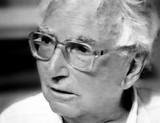
Viktor Frankl was a concentration camp prisoner survivor, Psychologist, Existentialist and author. His experiences within the Nazi death camps led him to form Logotherapy, from the Greek word Logos, which can mean study, word, spirit, God or meaning. Through observing who did and did not survive he concluded “He who has a why to live for can bear with almost any how.” He saw that people who had hopes of being reunited with loved ones, or who had projects they felt a need to complete, or who had great faith, tended to have better chances than those who had lost all hope.

Freud centred on a will to pleasure, as the root of all human motivation, whilst Adler a will to power. Frankl through Logotherapy postulates a will to meaning. He said "Everything can be taken from a man but one thing: the last of the human freedoms -- to choose one's attitude in any given set of circumstances, to choose one's own way". I find this statement powerful beyond measure.

He also went on to say “If a prisoner felt that he could no longer endure the realities of camp life, he found a way out in his mental life– an invaluable opportunity to dwell in the spiritual domain, the one that the SS were unable to destroy. Spiritual life strengthened the prisoner, helped him adapt, and thereby improved his chances of survival”.

Many slaves found solace and faith in Religion. Did this provide meaning within the meaningless that enabled them to adapt and survive? Christianity was also used by many to okay slavery which leaves a bad taste in my mouth because it feels like a double betrayal cloaked in further illusion for those who suffered at the hands of this inhumane ‘enterprise’. “Meaning must be found and cannot be given” said Frankl and so I have to also acknowledge that meaning is personal and so many would have found comfort in what resonated for them. Christianity appears to have acted as a personal and collective relationship with God.
 
I wasn’t there, I shouldn’t know, so why do I make these comparisons to slavery? And why do my emotions feel so strong? Beliefs and historical memories are re-awakened when in contact with a real or perceived external oppressive situation. Watching the film triggered and unlocked, emotions that were dormant. I have experienced this on at least 5 separate occasions prior to this and it is scary because there is no reference point to help provide meaning. Last year I came across the words Cellular memory and Internalised Oppression, the latter coined by Franz Fanon and everything just clicked into place.

My great, great grandmother was a slave and although I/we are generations removed from the actual experience of slavery, we still carry the scars of the experience thorough Cellular memory, also known as ‘Collective Colonial memory’(Tuckwell, 2002, p.39) in both our social and mental lives. Akbar (cited in Mackenzie-Mavinga,2003, pg 105) said “Psychologists and sociologists have failed to attend to the persistence of problems in and on our mental and social lives, which clearly have roots in slavery. Only the historian has given proper attention to the shattering realities of slavery, and has dealt with it only as descriptive of past events”.

Internalized oppression highlights the ongoing impact slavery; imperialism and colonisation have on the psychical level. Later writers use this term as well as internalised colonization and internalized racism. Alleyne (2004) said “It is the process of absorbing consciously or unconsciously the values or beliefs of the oppressor and subscribing to the stereotype and misinformation about one’s group...such a process leads to low self esteem, self hate and other complex defensive interpersonal behaviours” (p.48).


The legacy of the historical past has a traumatic affect in similar ways of post traumatic syndrome, where the pain and full acknowledgement is preferred to be avoided. What is the result of avoidance? How would this be displayed in behaviour? How can I/we fully heal if the unconscious does not become conscious? For me there are more questions now then ever before. Below are some examples of what I am thinking...

• I am a descendent of slaves, therefore what part of Africa did I originate from?


• My surname and family surnames are English sounding as far as I can go back, what is my true surname?

• What is my mother tongue?

• I fully believe in the notions of Cellular memory and Internalised Oppression as a result how much of what I do in my day to day life is motivated by proving “I am good enough?”

• How much of my culture, values and beliefs today are entwined with conditioning, trauma and fear from my historical past?

• Is who I think I am, really who I am? How can this be the truest essence of me, if a large part of my existence is informed by unconscious conditioned ways of behaving? Virtually raise your hand, or shout YES to the screen, if you can identify with this statement “You are black and therefore you have to work ten times harder than your white counterparts”. This is conditioning and this statement has been informed by our parents, parents, parents experiences, which is understandable however go deeper to ask who am I working hard for? What am I trying to prove and who am I trying to prove it too? Answer this honestly.

We all need to look at our ways of behaving as potentially this is another type of shackle. BE-ing is different from DO-ing. To BE is about reaching our potential and not proving our potential to others. Black psychologists such as Alleyne and Ellis speak of the ‘true black self’. This must exist because Cellular memory and Internalised oppression does. Therefore underneath the layers and layers of baggage that we unconsciously carry lies are truest essence. The answers also lie in finding out who we were before the trauma of slavery. Whilst I also believe that we can choose to define, re-define who we are at any given moment, acknowledging the past is also important.

Internalized oppression is a collective experience of black people (Tuckwell, 2002), as a result the likelihood of other black people experiencing similar thoughts and feelings triggered by any type of stimuli is high. This is the main reason I have decided to write this. The information is there but hidden away in books. If any of what I have said resonates with you, or makes you question or explore more, than I guess I have done my bit in highlighting the known.

I have never thought about visiting a Slavery focused museum before now. Avoidance I think played a large part, however due to the emotions triggered by The Rising of the Planet of the Apes and my previous reactions to other types of stimuli, it felt necessary. So last week I went to the International Slavery Museum in Liverpool to look at the past, connect the dots and process it properly, in order to reduce my own known and unknown historical baggage.

My review/thoughts and insights of The International Slavery Museum will be posted tomorrow evening.


References:

Tuckwell, G. (2002). Racial identity, white counsellors and therapists.

Mckenzie-Mavinga, I. (2003). Linking social history and the therapeutic process in research and practice on black issues

Alleyne, A. (2004). The internal oppressor and black identity wounding

Related Posts:
1.Dot to Dot:Part 2
2.Road Blocked
3.Stamps from the African Diaspora: Review

© Lisa Bent 2011
Senin, 26 September 2011

BEFFTA Nomination Blog of the Year

Hello everyone, I have some exciting news… my blog has been nominated for a BEFFTA award in the category of Blog of the Year. I am so happy. See below...

Newspapers/Magazines/Blogs

  1. Best Community Newspaper: Afro News, The Voice, Trumphet, Testify
  2. Magazine of the year: New African Woman, FAB Magazine, Nollywooduncut, Flavour, In-spired lifestyle magazine, Hotminute Magazine, Black Hair Magazine, Tropics Magazine, check out Magazine , Crux, Keep The Faith, Women Confidential, fashion finest, Afro Pulp, Lime Magazine, Oh yes, Urban World
  3. Journalist of the year: Topi Lyambila, Henry Bonsu, Ayo Johnson, Stephen Ogongo, Janelle Oswald, Charlene White, Annika Allen, Lukwesa Burak, Jumoke Fashola, Precious Williams, Rageh Omar
  4. Blog of the year: Shadders.net, belindaotas.com, Africa Fashion Guide, Soul Culture, msafropolitan, Deeper than Twitter, Bella Naija, Art Hustle, Bee Suarez, Miss Jestina George, Mo-am network, Not Just ok, pappzd, The Norte Blog, Africa Bati
BEFFTA stands for Black Entertainment Film Fashion Television and Arts. Each year through the award ceremony, they “Honour the best showbiz and entertainment personalities in the black and ethnic communities in the UK, USA and globally. BEFFTA Awards is the first of its kind rewarding, under one roof outstanding achievements and contributions from Africans, Caribbeans and Asians in entertainment, film, fashion, television and arts. This international prestigious ceremony celebrates an all round accomplishments of a hard working community within entertainment and showbiz especially the unknown talent that need exposure. The awards ceremony founded by Pauline Long also aims to inspire black and ethnic personalities worldwide to achieve at the highest levels”.  
I would like to thank everyone who has taken the time out to read my mini essays, rants and insights and gone on to share with others through word of mouth, tweeting, and re-tweeting, it is greatly appreciated as it is you guys who have helped  put me on the radar.I often feel as though I am swimming against the tide, this is my choice and to be acknowledged and  celebrated for it is fabulous.  

Voting begins on Saturday  1st October and the awards take place on Saturday 22nd October. All the details including other categories and other nominees can be found on the BEFFTA website
If you wish to vote hint hint :-) click here http://www.beffta.com/news/?page_id=7

Thank you again... Wish me luck :-)

Kindest
Lisa Bent

Related Posts:
1.Future 100 Award Winner

© Lisa Bent 2011

Rabu, 14 September 2011

Welcome to the UK!

This morning Kelis with her son, touched down in London Town, unfortunately unlike the good feel tune by Estelle, the experience was one of disbelief, anger and so much more. I read what happened via  Parlour Magazine  who displayed her twitter feed see below...

“We just landed and I had the midget with me. We get in the passport control line and apparently pissed this one man off cause he thought I cut the line. Which wouldn’t be far fetched of me but this time I actually didn’t (not entirely anyway) well the point is from 0 to 60 this fat red faced sweaty “man” (I use the word man loosely here) started calling me a slave and told me to call him sir and how I was probably a disgusting nigerian. He called me kunta kinte and ranted and raved some more. The man behind the passport desk laughed, shook his head in agreement I guess, and said “kunta kinte”. All the while the entire line full of people I just sat on a plane with for almost 3hours, over 50 people said nothing. I mean literally nothing. Didn’t flinch. We all no I’m no saint, so I retaliated. Not the way I wanted to or how that pig deserved. But #1 my gorgeous baby boy was literally sitting on my hip and #2 I’m a believer. And we are better. Sposed to be anyway, it made me think. This person was aprox a 50 year old english man. I didn’t say anything at the time of the riots in London for a lot of reasons. But I am in london all the time and today I’m gonna say that the racial issues in the uk are disgusting. Its racially decades behind progression because everything is swept under the rug. People don’t talk about it. People don’t fight about it. Not mentioning a problem doesn’t make it go away. I bring it up now because as an american it is abundantly clear that my country has a smorgas board (spelling?) Of disgusting racial problems. We are the poster child for racial inequality even still with a black president. But its NO SECRET! And that I can fight against. I can try to prepare and teach my son. Because its out there. But you can’t fight for or against something no one is willing to talk about or even admit exist. Everyone wants to be politically correct. But who really cares? And what does that help. I could go on and on. I won’t. But maybe someone will start to talk about it from here.”

Next year, due to the Olympics, this country will open its doors to a wealth of diverse people, is this going to be their treatment? What a great welcome that will be eh?This is disgusting on every level and I hope the two people in question get sacked of immediate effect.

He called her a “slave” told her to call him “sir” whilst also revealing how he feels about Nigerians in particular. This is racism, discrimination and prejudice in all its ugly glory. He is in a position of power and clearly takes pleasure in abusing it, who else has been made to feel inadequate, less than and inferior due to this man and his colleagues (some) of whom share his beliefs?

The Kunta Kinte reference was shocking and rather than giving explanations as I usually do, I will leave it for you the readers to do your own research. Why? Because those who are intrigued will search and the experience you gain through this will resonate in what ever way it is meant to.
I was not born in the era of slavery but trust me when I say this scenario gave me a glimpse of the past, whilst showing me a contemporary present. Although progress has been slow, I refuse to accept that this way of being will also be in our future. The present, as Kelis has revealed and which I have expressed in previous articles, is one cloaked in the illusion that everything is fine… when clearly it isn’t.

For those that are avid readers to my blog you will know I can go deep into this, however today I choose not to, because it is not necessary. The racism is there for all to see in black and white.

Over the weekend I saw pictures of extremists and The English Defence League protesters-clash-at-911-memorial-services in London and for the first time in ages, came the realisation that these people could be teachers, doctors, paramedics and even custom controllers. People can hide their thoughts and beliefs behind uniforms and titles because we are conditioned (and rightfully so) that these people in the public sector and in helping positions are there to provide a friendly service. The reality is that a uniform does not make you, you make the uniform.


I will end with a couple of questions for everyone to ask themselves
What is racism to you?
Would you say you were a racist?
What views do you have of people that are of a different race or culture to you?
Step outside of yourself and view Kelis’s situation, what feelings come up for you?

You may not like what surfaces, but it is important to look at it otherwise you are part of the present problem, which is the denial that racism exists through the further potential denial that you hold racist views. To deny without further enquiry is still denial probably triggered by fear.

I personally think questions like the ones I have presented above should be part of the interview process, as I said, the uniform does not make the person because no matter what job you have or position you have acquired, who you are is central to everything.

So who are you? What are your views?

Related Posts:


Rabu, 13 Juli 2011

Inspirational YOU

Avid readers of my blogs will know that I am all for social change and new ways of thinking for the promotion of personal and professional development. I write because I have something to say and if what I have said has stirred you in some way then that is a bonus. Words are powerful and even more powerful when they travel directly to the ears of many in a sharing forum. I expressed the importance of this within my review of I’m POSSIBLE recently and I would like to stress this again through Inspirational YOU.

Inspirational YOU is a non profit organisation whose aim is to inspire those who aspire, therefore this event is ideal for social entrepreneurs, students, budding writers, photographers and perfect for those who do not yet know what direction in their career path they what to take.

I attended Raising the Bar on Saturday 25th June, the turn out was strong with a diverse age range. The day consisted of different workshops and seminars, which I walked in and tipped out of in order to experience  the full range and feedback to you.
I really enjoyed Leading Ladies as they were open and engaging, gave great tips in a concise way, whilst revealing their personalities. The speakers were Sophia A Jackson (Editor/ co-founder - Lime magazine & Editor/founder - Afridiziak Theatre News), Jodie Dalmeda (Head of Media & Artist Management at Virgin Unite), Tenneka Campbell (Floor Manager at ITN), Sinem Bilen-Onabanjo (Editor-in-chief, Fab Magazine), Linda Asafo-Agyei (VP at Barclay Wealth) whose tough love attitude and humour was admirable and Edna Agbarha (Business Psychologist) best known for her appearance in The Apprentice. Hearing Edna speak reminded me that The Apprentice is an entertainment show and as long as editing is involved you will NEVER see all sides to a person. Edna knows her stuff. I loved how she applied psychology to business when giving tips on how to succeed. I may have found how I can make proper money out of being a counsellor. I kid you not, we need to eat to.
 Photograph by Desmond www.olmecphotography.co.uk
Never spoken but it was there, the ladies had a mutual respect for each other whilst sitting firmly and comfortably in their own shoes.
                                                                                     
I also enjoyed What do men really think? The guests on the panel were as follows, Matthew Ryder (QC), Kevin Bennett (Entrepreneur and founder of www.kbenaire.com), Alphege Bell (Barrister), Paul Hampartsoumian (Celebrity photographer), Charles Thompson (Founder of Screen nation) and  host and Barrister Gary Green. Naturally the dynamics and tone were different to the talk before with the ladies, so I will not compare, however I will say that the responses from the majority on the panel could have been more concise. Short and sweet sometimes makes more of an impact. 
                                        Photograph by Desmond www.olmecphotography.co.uk
The seminar title bugged me somewhat and I know I am being picky but Leading Men I feel fits better as the seminar was of the same theme as the ladies but from a male perspective. The title is too wide and one which I immediately associate within the context of  relationships (LOL). I acknowledge this is subjective, however it may explain why some of the questions from the audience seemed to range further a field. It was however a good seminar. 


I also managed to see and catch up with entrepreneurs Jessica Huie of Colour Blind Cards and Tanesha Westcarr from Styling Says,  who both had stalls and were promoting their products. Both Truly inspiring women.
                                               http://www.colorblindcards.com/


Nigerian Born uber talented designer Ngozi Pere-Okorotie the creative head behind Zed-Eye designs stole the fashion show, which was organised by fashion stylist to the stars Denise Brown. Entertainment blogger Miss Lala and I were very impressed.  The London College of Fashion graduate, who takes inspiration from fashion goddess Vivienne Westwood and from her culture has had her clothes worn by Kelis, Shingai Shoniwa from The Noisettes and more recently by Nollywood actress Genevieve Nnaji. If you don’t know about Zed-Eye, it’s not to late to find out.


                                                                                       www.zed-eye.com
If you are searching for something, I guarantee, you will find a gem, a trigger, a word of wisdom or a new contact at Inspirational YOU that will take you one step closer to knowing or being where you want to be.

I cannot write this without shining a light on Sonia Meggie who is the founder, the vision and therefore the backbone of Inspirational You. She has crushed the Each one, Teach one rule, as through her events Each one, Teaches many! Thank you for providing a free accessible service that promotes everyone to aspire. Now it is up to YOU to utilise it. Get involved.
  Sonia Meggie
Photograph by Desmond www.olmecphotography.co.uk


Related posts: