

Black is...
Slavery was...
I am....
I was hesitate as I walked up the steps and into the International Slavery Museum
The dimly lit room quickly set the mood, heavy, thick, dense and oppressive. Each step was greeted with voices of the past through quotes carved into the walls. This one in particular stood out for me

How insightful? How true? How sad! I have only ever focused on their pain overlooking their courage.
The museum holds a wealth of information stemming from and explaining...
- How Slavery began
- The middle passage voyages
- How slaves were treated
- Who profited and the economic benefits of slavery
- The impact of Africa
- Global inequality and contemporary slavery
- From the shores of Africa the influence of black music today
- Exploration from various voices as to what it means to be Black British, African-American or of African decent in different parts of the world today.
The photographs I am about to include are based on what resonated most with me, coupled with brief comments before expressing further thoughts and insights.


My mouth hung open for sometime before making a few comparisons that are thoughts and questions and ones that probably will remain that way.
If cellular memory exits and black people as a collective have internalised Oppression than there must be an opposite for white people. I have heard of white privilege and white guilt but is there more within their unconsciousness? What is the conditioned behaviour and how would this be displayed due to their historical past in the present?
If cellular memory exits and black people as a collective have internalised Oppression than there must be an opposite for white people. I have heard of white privilege and white guilt but is there more within their unconsciousness? What is the conditioned behaviour and how would this be displayed due to their historical past in the present?

This weekend a friend posted to me Michael Moore's A brief history of The United States
Interesting right?
I cannot and will never be able to fully imagine what it must have felt like to be shackled.These shackles are from the Late 18th Century and were found in Tamale,Northern Ghana .
I cannot and will never be able to fully imagine what it must have felt like to be shackled.These shackles are from the Late 18th Century and were found in Tamale,


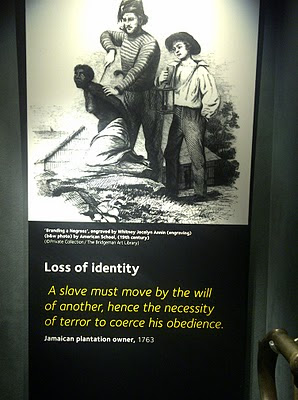

"Africans were branded with hot irons, no differently from cattle to mark them out as possessions.Plantation owners and slave traders alike justified their atrocious actions by claiming that black men, women and children were closer to animals than they were to white people."
In regards to the branding of slaves, I have always wondered whether this has informed my dislike for tattoos. Perhaps I simply just don't like them.

"Sold, branded and issued with a new name, the enslaved Africans were separated and stripped of their identity".
In the picture below you can see that their names had been replaced with English sounding names. On the fourth line down a man was given the name "Nobody".

The sensory room is interestingly powerful. The sound of the waves and the quick glimpses of shackles and vomit successfully conjure up the severe confined space, restriction and confusion. As I'm in there I remember the time I was sick on the ferry on the way to France
“A churnel stench, effluvium of loving death spreads outward form the hold, where the living and the dead, the horribly dying, lie interlocked, lie foul with blood and excrement”. Robert Hayden, 1962
I sat in another room and listened to an African women tell the heart rending story of her children being captured and enslaved. This was the first time that I fully acknowledged the two way process of loss. Children and adults were removed from their families by force and entered into the unknown. The people left behind also entered into the same grieving process and uncertainty. The level of trauma to both sides is immeasurable and further heightened when friends, siblings and relatives who were taken together were sold and separated.


The model of a plantation was informative.When you pressed the button certain areas would light up giving a visual description coupled with the written. The harsh realities of slavery gave mercy to no one, not even pregnant women. Their babies were important, they were future workers and so before punishment proceeded women were forced to lay face down, where a hole dug into the ground accommodated and supported their swollen bellies, before the reign of lashings commenced. We know the stresses of a mother can cause distress to an unborn child and so whilst physical harm did not occur, the damage had already been done. The mothers energy, emotional state is passed onto the child proving scars of slavery are both visual and psychological, whilst strengthening the notion of cellular memory that I raised in part 1


As the risk of being taken was high, many equipped their children with knowledge in how to best survive. This makes sense but can you imagine the level of anxiety this must have caused in both the parent and child? They were prepared from an early age and I now see the residue from the past and into the future with “Your black and you have to work ten times harder than your white counterparts”. The line between preparation and conditioning appears to have merged into one to such a degree that I linger over the very real possibility that Black people expect hardship and learn to deal with it, get on with it. We have been expected to be strong and have been for centuries. “What wont kill you, will make you stronger.” I wonder where this saying came from?
The model of a plantation was informative.When you pressed the button certain areas would light up giving a visual description coupled with the written. The harsh realities of slavery gave mercy to no one, not even pregnant women. Their babies were important, they were future workers and so before punishment proceeded women were forced to lay face down, where a hole dug into the ground accommodated and supported their swollen bellies, before the reign of lashings commenced. We know the stresses of a mother can cause distress to an unborn child and so whilst physical harm did not occur, the damage had already been done. The mothers energy, emotional state is passed onto the child proving scars of slavery are both visual and psychological, whilst strengthening the notion of cellular memory that I raised in part 1

"Being regarded simply as property, devoid of any human rights, meant that enslaves Africans were exposed to the most ruthless abuse and crippling work load. Such atrocities went unchallenged because chattel slaves had no right to complain".
'Chattel' is an old word for property.

"They were divided into three work gangs. They were also divided against each other”.
This sentence stood out for me. In my earlier post Road Blocked , I highlighted The LA Crips and The Bloods to help explain the ridiculous “postcode”/“turf” wars that are present in London
Self-hate and black on black crime; could this be a conditioned way of being as a result of slavery? If so this may partly explain why no young person can coherently and consciously explain why they do what they do. I am not removing blame or condoning the actions of those who do wrong, I am trying to extend beyond the current suggestions that have led, in my eyes to the same place, a regurgitated dead end. Perpetrator and victim seems to be the stagnant back and forth line that leads to no where. For the first time I clearly see the meaning within the meaningless.
Slavery still exists in both visible and invisible shackles...

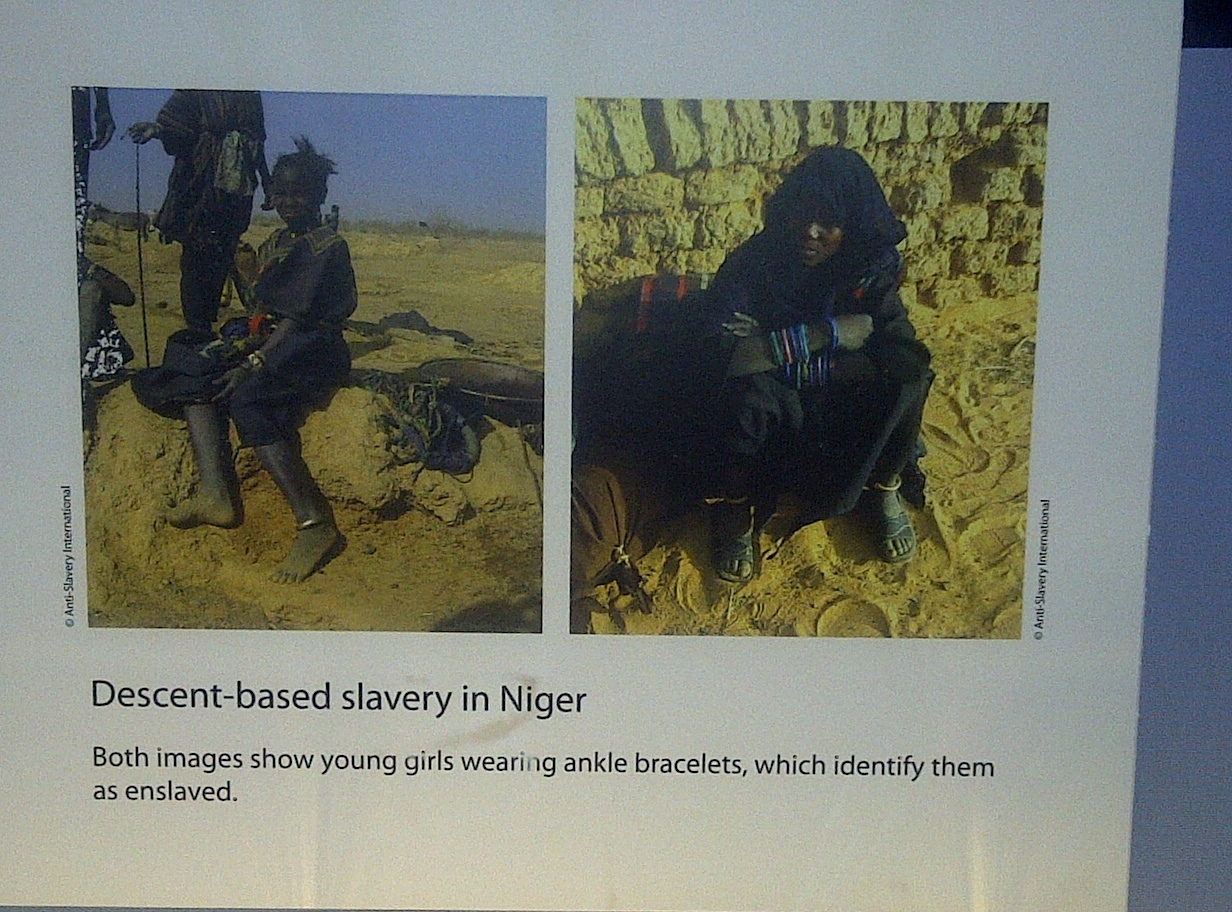
...though we rarely see the visible. However we know trafficking, exploitation and forced labour exits. As I entered further into the contemporary slavery section of the museum, I felt the list of what constitutes as modern slavery also needs to include Gangs.Why? The idea of an extended family originated from an honest, caring, helpful, community based place. However though time to the present day I only see a unit that is based on targeting, grooming, initiation, bullying tactics from “elders” to “young uns” emeshed in fear, force, power and control, clocked in the illusion of togetherness, loyalty, protection and progression. As a result I agree with this quote
"Slavery still exists. Indeed it is more diverse and entrenched than it was ever before."
-Gloria Steinhem, 2006
We respect history in the forms of folklore, stories, quotes and antiques passed down from generation to generation. These are our ancestors external imprints, cellular memory and the known factors that are embedded within it, is our internal ancestors imprints. There are many questions that I still have, however connecting the dots in light of found information is enabling me to make some connections. Of course this is my subjective processing and therefore only an opinion, it is not fact however many arguments and even "facts" have been built on less information.
Although the past may well be in the past so much of the present appears to be informed by it, in ways that I hadn't before considered. Historians through finding physical evidence are able to built knowledge from an era that no longer exists. Hard and scientific evidence is given more value than the unseen, in spite of the knowledge in human behaviour through psychology and the acknowledgement that possibilities are vast and endless. Slavery did take place and still takes place, though in different forms as we know, therefore my concept of gangs being a form of contemporary slavery is definitely out the box, but plausible and a new angle for further exploration.
I didn't know what I would gain from visiting the museum because dread didn't allow me to think any further, however the experience has been refreshing and enlightening. I would recommend everyone to visit this museum at some point to see and experience the history in full as it is presented.
...a strange metaphor to describe a group of people
...an inhumane event in history that has transcended to new meaning
...I am in the driving seat of my present and future because I am conscious of the impact of the unconscious.
EXTRA NOTES:
Gang members are like 'child soldiers' says iain Duncan smith see article here
http://www.thisislondon.co.uk/standard/politics/article-23993914-iain-duncan-smith-gang-members-are-like-child-soldiers.doBased on my above thoughts I would have to agree. However I wish politicians would learn to breakdown their statements to provide further meaning, as this alone sounds like a shock tactic emotive based sentence that restricts many from making the insightful contemporary comparisons.
Related Posts:
© Lisa Bent 2011


