

Tampilkan postingan dengan label education. Tampilkan semua postingan
Tampilkan postingan dengan label education. Tampilkan semua postingan
Kamis, 10 Oktober 2013
Sharing Rubrics in Schoology -- It can be done!

Minggu, 19 Mei 2013
Leading by Example with regard to Evaluations
The old saying goes that the best teaching method is modeling behavior and I believe it is true. Which makes me wonder why so many international schools fail to have transparent evaluation processes for their leadership positions. I've been to three international schools as an employee and many more for conferences/workshops/presentations, and the rule has been a lack of evaluation for administrators. As a budding educational leader, I see this as a major hurdle in international education. How can we expect to judge the value of others, if we aren't held to the same standard? It is an ethical and professional dilemma in my mind. I know as educational leaders we are forced to make some tough decisions, and that those decisions leave us open to criticism that could be unfair or bias, but does that allow us to avoid transparent evaluation? I think not.
In fact, it is more of a reason to have transparent evaluation and feedback avenues for faculty, staff, parents, and students. It is similar to the idea of a free press. When a truly free press exists, society's issues are aired openly and discussed in a public forum that allows for multiple view points. With a controlled media, the public feels disenfranchised from legitimate methods of discourse. This results in vandalism, violence, and revolt. A healthy democratic society, which I hope schools try to be, runs more smoothly with a free press. Think of transparent evaluation for administration as your school's free press; it allows the society to vent issues in a constructive manner rather than destructive.
West Virginia as developed a rubric and evaluation system for educational leaders that is an excellent starting point for schools that are looking to improve leadership and model reflective practice. I'm hoping that these type of systems become the norm in international schools in the future rather than the anomaly. In the past at KIS, Robin Schneider (@robin_ISH) used Google Forms to gather data on his job performance as the middle school principal, which was something I admired and appreciated about him. He was not required to do this by the school, but wanted to model reflective practice and the importance of evaluation for all teachers and administrators. It is too bad that his efforts ended after he left the school.
Rabu, 20 Maret 2013
Using Google Spreadsheets for Meeting Agendas
Do you really want your team to collaborate? Do you want to be able to digitally track your meetings, decisions made, actions assigned, and who and when items will be followed up on? The EdTech Team at Korea International School wanted to have these options. During a meeting Steve (@stevekatz) was introduced to this amazing tool by Rolly (@rollymaiquez) from Chadwick International School. It has revolutionized our team and dramatically increased our productivity. I have created a Template that can be used by any group or team; in addition, the instructions on this post will have you ready to be more productive and more collaborative for your next meeting. After following the link, make sure to create a copy of the template from the File Menu. This will give you your own copy in your Google Drive. PLEASE DON'T EDIT THE ORIGINAL!
 |
| The Template looks like this and you can customize all the features. |
 |
| You can input your team members with this trick. You can also adjust the Priority/Status list this way. |
Minggu, 17 Maret 2013
Engaging a Student's Passion

I'd like to talk about student engagement; I'd like to talk about allowing students to follow their passions and supporting them. I'd like you to consider how Facebook and other social media sites can make your students develop and grow in ways they are interested in, not in ways they are told to be interested. This is a piece of evidence from Korea International School. Colin is on of our students; Colin happens to be a very gifted piano player. This is Colin's SoundCloud page. Look closely. Do you see the number of followers he has on his page? 12,958. 12,958! Almost 13,000 people listen to this kid's music. By the time you read this blog post, he will have more than 13,000 followers. Amazing! And how has this impacted Colin? His confidence in his musical abilities has grown; his confidence in himself as grown; he is a musician with an authentic audience. This has occurred because we do not blog Facebook or SoundCloud at KIS. In fact, we don't block any social media sites at KIS to encourage innovative collaboration among students and teachers. We don't recommend teachers friending students in social media sites, but we do encourage using features like groups and pages within social media sites. Many of our teachers supplement course instruction with Facebook groups; almost all of our clubs are ran by Facebook groups and most of these are student led. Below is a screen shot from my Film Makers club. More correctly, I should say the student's club, because three students who are passionate about film making approached me last fall about being an advisor for their club. Here are three students who are very passionate about a topic that used Facebook to promote and manage a club. Now there are 20 students in the club and they organize and arrange filming for club block and outside of club block via the Facebook page. They remind each other to bring costumes, props, equipment. This type of engagement could be done in Schoology or Edmodo, but the students prefer Facebook. They feel like they have ownership when they use the tool that they prefer, not the one we prefer. If you are blocking social media sites at your school, stop. You can tell yourself that you are protecting students and teachers; you can tell yourself that you are modeling best practice with technology; but in reality, you are simply slowing down the learning and collaboration for everyone.

Sabtu, 15 Desember 2012
Beyond A-C

This week I took the day off to volunteer at a school to talk to 14 -16 year olds about their career options. I pushed my judgement that the majority of children have aspirations of being a footballer, wag or rapper aside and walked in armed only with water, Strepsils and my note book.
The set up was like speed dating. Fourteen volunteers like myself sat at a table with their name and career titles on the desk. Each pupil had 4 minutes to ask any questions or concerns they had before moving to the next desk indicated by a bell. I cannot tell you how may pupils I spoke to that day only that the Strepsils came in handy and at the end of the day I left feeling intrigued, happy and concerned. So how was it? What did I learn?
I remember what it was like when I was their age like it was yesterday. I felt apprehensive and pressurised to do well in my G.C.S.E’s because my WHOLE life depended on it. Opening my results was the scariest thing I had to do at that age (scarier than cleaning out a whole chicken) and I remember the relief when I saw the first 3 letters of the alphabet stare back at me with one star thrown in on 10 subjects. I was happy and it felt like this black cloud and heavy weight instantly lifted. The relief was short lived as immediately after the next challenge was to go through clearing as although my results were good, I didn't get what I needed to get into my preferred university. The biggest myth is that your future success is dependent on what grades you receive. This is not true, which I'm sure many of you will now know.
Sixteen years later and the same dread is alive and kicking amongst the young. Education is important, there is no doubt about that, however the obsession with league tables has become the death of education. The education system has always been one that values results. Good results mean that teachers have done their jobs well. Pupils seek validation from teachers and teachers feel validated over their own worth and performance by how their pupils perform. This is a system locked in external approval and validation. It is a co-dependency and more so now with the government wanting to pay teachers based on their performance which is based on pupils results. This country has always had a strong academic structure however what appears to be lacking is pupils own passion to learn. Does the pressure put them off?
Pupils are individual people with individual capabilities; however this is not always recognised within their grade. Not everyone is academic, for those that are not, are their other abilities and skills ignored due to time constraints and resources?
For the pupils that had received their predicated grades I noticed two things. Pupils who received expected grades of A-B were confident and tended to have their further education planned and careers mapped out. Although their expected grades were good they identified they could do better and work better. For those who had expected C grades and below had become resigned to this “fact” and didn't really have any future plans, hopes or dreams which shocked me. They had already given up or were willing to do just enough to get a C as “It’s a pass miss”. It made me question the benefits of expected grades. Yes the idea of it is obvious and the hope is that they aim for a better grade than their expected one. However this could also work the other way and become a self-fulfilling prophecy for those who aren't in the top grades. How well you do in exams is determined by how well you perform on the day, which needs to be stressed.

In my blog Rat+bird=fish? I spoke about the rising issues within one to one communication as a result of social media. I saw it first-hand amongst the pupils through their lack of eye contact. Whilst I acknowledge shyness can also be a cause for this, I don’t for one seconds believe all the pupils I interacted with were naturally shy. I can count on one hand the amount of pupils who spoke clearly confidently whilst meeting my gaze. I have no problems holding a gaze and for the first time I had to think whether my level off eye contact made them feel uncomfortable. It was definitely a serious thought but an action I was not going to change.I invited them to look at me when they spoke instead.
I understand this...


Lessons in how to communicate face to face is a new reality and a necessity. Attaining good grades is great but so is having basic social skills. The majority of children today spend a lot of time with their heads down as they tweet, text, whatsapp, bbm and whatever else the world of apps has to offer, which is clearly having an impact. Whilst the level of engagement in social media is apparent it appears using it as a source of research is lacking. When I asked pupils what their ideal job would be, three pupils gave me really amazing sounding titles. When I asked them to break down what the job would entail and what qualifications they needed, none could elaborate. Gone are the days when research needs to be done via books or through the advice of career advisor's There is a wealth of information at a click of a button and yet I get the sense many are not utilising the internet in other ways that could really benefit them.
In spite of my above observations all the pupils I spoke to had potential, it just needs to be recognised, identified and nurtured which needs to extend beyond school. I also saw a handful of truly gifted and special pupils who were not necessarily in the A-C bracket. They are entrepreneurs of the future. If I was to put an association/title to it, then I have seen the next David Attenborough, an inventor to a new type of aeroplane never seen before, the next great presenter to come out of the UK and a multi-skilled musician and composer.
I love working with children, I always have. I laughed with them, offered guidance whilst being very challenging to push them beyond their perceived limitations. I heard way too many “buts” for my liking. But is a defeatist word, a dream killer that doesn't provide space for other considerations…in my dictionary. Adults need to communicate positivity and reveal to all the potential they see, whilst encouraging them to stretch their imagination and see other paths and solutions. A lot is going on for pupils at this age from growing up, finding out where they fit in, questioning whether they fit in, on top of understanding who they are , what they like and what they would like to do in the future. We need to give them hope, and help them create their ideals. If we don’t instil the possibility of everything, than at what age will they know and believe this to be an option?

“Miss are you psychic” a pupil asked in response to me telling him of all the things he could do as a career based on his interest. “No, but I see all that you are and I want you to see it for yourself rather than listening and being intrigued by what I'm telling you”.
This is my aim whilst working with children and to be honest this should be the core infrastructure of education. Work with potential, passion and spark and better results will be the outcome, coupled with young adults who enter into the big wide world with confidence and the belief they have something to offer and can be anything they put their mind too; rather than as individuals who believe they have to wait for an opportunity to be offered and can be anything they want only when it is behind the computer screen.
© Lisa Bent 2012
© Lisa Bent 2012
Selasa, 01 Februari 2011
Built on Shaky Foundations

It was reported that the government want to ensure that all pupils can read and write and yes you have guessed it, want to implement another test system to ensure this happens. I am baffled as to why we do not adopt the American system, where pupils who are not at a particular reading and writing ability drop back a year until they are on par. The system by now should be full proof, so that the foundations that are built on top are flexible to fit changes within societies and pupils needs.
I make this point as pupils of today face a wealth of problems more intense than I ever had to encounter in my day. Observations need to be noted and understood to implement change that helps them, after all it is about them which the government seems to have forgotten. The current state suggests that it is all about league tables which help support the appearance that Britain’s education system is still of a high standard. The longer this façade and puffed out chests with swelling egos remain, the further the education systems slides into a pit.
So what needs to change? The sooner we stop living in past “glories” the better. The past is gone, never to return so whilst Henry the VIII is an interesting subject, current and present happenings need to be explored and understood to the same depth. The issues that children seem to be dealing with are:
Bereavement- The number of teenagers killed since 2000 is alarming. The degrees of separation between an individual and victim I’m sure is less than 6.
Sex – Sexual pressure is on the rise and seems to take the form of abuse, bullying and exploitation. Transactional sex (The exchange of sex for material possession) is also on the rise as is teenage pregnancies, STD’s and HIV.
Behaviour- The lack of respect, responsibility and compassion is shocking. Girls especially have become quite brutal in their behaviour and speech. These are mothers of tomorrow.
The extent of the past cannot be truly acknowledged and taken in, if the majority of pupils are sitting there fearing whether they will be stabbed on the way home tonight. Maslow’s Hierarchy’s of needs encapsulates what I am trying to say. If the basic needs are not met, then an individual cannot even begin to think about anything else. The pyramid levels are below.

In this case the basic needs are safety, which for many pupils is not met within their environment, as a result the ability to concentrate in class, if they turn up at all may not be present. Love, unconditional love could also be lacking so it is sought for in other areas.
Like maths some theories can be applied to any situation. The key is that the formula needs to be viewed within various environments. Making use of what has been before with an open mind means that we move away from rigidness and repetition to see things in a different light.
It is also important to acknowledge that this generation are born into the technological new age. When I left school computers were only beginning to make an appearance. What worked before will not have the same impact now. The children of today are fabulous multi-taskers though with poor attention spans because they have access to everything at a click of button. Whilst to my knowledge there is no research evidence to prove this, I am calling upon common sense. So unless the lesson captures them, it could be reminiscent of watching two people playing conkers! They are not from that era, though the educational system is. Technology, society and children have changed therefore so must the lesson plans.
Teachers need more support, less paper work and more creative freedom /resources when teaching. Power needs to be given back to teachers as currently pupils seem to have it. However teachers being given the power to search pupils and remove materials they deem to be a distraction in class as proposed last week, is not the way forward. The one thing teachers and pupils have in common is the safety issue. Teachers don’t feel safe in the classroom and pupils don’t feel safe outside the classroom. Related and unrelated in the same breath, the impact, friction and energy being given off is evidently fear and powerlessness displayed in both adult and pupil in different ways.
The foundation of the educational system needs to change to extend beyond reading, writing and league tables. It has to encapsulate morals, values, respect, discipline and rules, whilst moving away from the regurgitation of information and memorising, to the development, harnessing and support of ones ability to think for oneself. Thought turns into awareness, awareness transcends to choice, choice into responsibility which travels beyond the education system and into society as a whole. The education system as it stands does not currently do this; as a result those who leave without specific grades are made to feel less then. If everyone was taught to think, perhaps there would be a few more Richard Branson’s in the world. He, as we know is a multi millionaire and extraordinary entrepreneur who left university with one O’ Level.
 So how much of a role does a piece of paper have in regards to future success? Each case is individual so it is hard to measure; though people like Richard Branson prove that it is not vital. The education system does not and has not pushed people to think beyond what they are told and this is the problem. It is in the government’s interest to change the education system to help create the future leaders of tomorrow, as it is this type of forward thinking that builds entrepreneurs which in turn can build prospects, jobs and raise economy. This is the way forward especially in light of the high cost of education.

The reality is that society is controlled by power hungry service to self individuals that keep wealth and control within the elite. Collectively enhancing the masses so that everyone has the ability to reach their full potential is unfortunately not on the consensus agenda.

Related Posts:
© Lisa Bent 2011
Kamis, 17 Januari 2008
Vote / Debate Online Social Networking for Education

The venerable Economist magazine is holding an online debate and poll on the topic of Social Networking for Education.
I am obviously in the Pro- camp on this one. Like many Anti-Social Media in Education arguments, the Economist author finds selective shortcomings in different corners of Social Media and paints a broad condemnation of the entire field.
I am using Ning.com in a class this semester at the National University of Singapore and I think it is working great. The class is currently only viewable to the students, but I do plan to open it to world after the semester has ended. (The students will be allowed to edit or remove themselves and their postings before I do that.)
-----
P.S. - I have not posted anything to this blog in awhile. I guess I have been distracted. Now that I am getting settled in Singapore (just visiting for this semester), hopefully I will get back to some regular posts! -- Alan
Kamis, 11 Oktober 2007
NAU Technology Faculty Survey - Google Doc's Presentation

This is a short presentation that I am giving in a couple of hours. I created it with the Google Docs presentation tool, which works fairly well. I just wish there was an off-line version, just in case the Internet goes down just before my presentation time!
NEW: Note in the Comments that is is possible to save the presentation as an HTML file (with supporting folders) on your computer, which then allows you to show the presentation offline using any browser.
Click the Title Above to Start the Presentation.
Kamis, 14 Juni 2007
University Librarians Emotionally Debate Web 2.0
From: The Chronicle: Wired Campus Blog: 'Everyone's Tripping and It's All Free':
Calling upon Mr. Lanier’s notion of “digital Maoism,” Michael Gorman, the former president of the American Library Association, depicts Web 2.0 as “an unholy brew made up of the digital utopianism that hailed the Internet as the second coming of Haight-Ashbury — everyone’s tripping and it’s all free.”
Mr. Gorman's stinging critique of the undermining of academic authority by user generated Web 2.0 (e.g., Wikipedia) is met by equally stinging responses and discussions by blogger librarians. Links can be found in the original article, or here:
- Two posts on Britannica Blog by Michael Gorman
- Jaron Lanier, who previously expressed similar concerns in a much-discussed essay
- Two Academic bloggers have challenge Mr. Gorman’s arguements
Minggu, 20 Mei 2007
Web 2.0 Ideas for Educators - eBook

TeachingHacks.com provides a free and very interesting eBook titled:
"Web 2.0 Ideas for Educators: A Guide to RSS and More"
by Quentin d'souza
Download the PDF book here
and go to the blog page that supports the book here
The guide is designed for K-12 educators, but with the current state of Web 2.0 in Higher Education (very limited in my view), I do not think there is really that much difference.
Here are two chapter from the Table of Contents:
IDEAS TO GET YOU STARTED
- SOCIAL BOOKMARKING AND RSS
- WHAT IS SOCIAL BOOKMARKING?
- HOW IT WORKS?
- BLOGGING AND RSS
- WHAT IS A BLOG?
- COMMENTS IN BLOGS
- WIKIS AND RSS
- WHAT IS A WIKI?
- SHARING RSS FEEDS
- PHOTO SHARING AND RSS
- WHAT IS PHOTO SHARING?
- HOW IT WORKS
- SHARING LEARNING OBJECT’S
- K-12 Learning Objects Shared Through RSS
- CLASS AND SCHOOL INFORMATION
- TRACK DISCUSSIONS
Minggu, 13 Mei 2007
EDUCATIONAL PODCAST DIRECTORIES

EDUCATIONAL PODCAST DIRECTORIES
Here is a list of directories to educational podcasts. Educational podcasts range from university classes, to elementary school news, and from pay-per-download ebooks to free DIY (do it yourself) tutorials. All of these are worth checking out.
Learn On The Go - Nice, clean interface; Nice organized list of university podcasts; Designed for general public interest
Learn Out Loud - Includes a lot of pay-per-download audio books mixed in with the free stuff -- made it somewhat confusing to me; Designed for general public interest
Podcast Directory for Educators, Schools and Colleges - More educator and school-oriented (all levels) than the those above, though also includes professional training and learning about podcasting.
The Education Podcast Network - Podcasts are listed by academic discipline so they can be used in classrooms and for home schooling. This one is the most school-oriented of these four directories.
Open Culture: University Podcast Collection - A listing of links to university websites where podcasts can be found, with xome comments on what is available. (I reviewed this site in more detail previously.)
Kamis, 10 Mei 2007
Theory and Practice of Online Learning

Theory and Practice of Online Learning - Free eBook from Athabasca University.
Here is the TOC (table of contents), because practice really works best when supported by theory:
Part 1 • Role and Function of Theory in Online Education Development and Delivery
1 Foundations of Educational Theory for Online Learning - Mohamed Ally
2 Toward a Theory of Online Learning - Terry Anderson
3 Value Chain Analysis: A Strategic Approach to Online Learning - Fathi Elloumi
Part 2 • Infrastructure and Support for Content Development
4 Developing an Infrastructure for Online Learning - Alan Davis
5 Technologies of Online Learning (e-Learning) - Rory McGreal & Michael Elliott
6 Media Characteristics and Online Learning Technology - Patrick J. Fahy
Part 3 • Design and Development of Online Courses
7 The Development of Online Courses - Dean Caplan
8 Developing Team Skills and Accomplishing Team Projects Online - Deborah C. Hurst & Janice Thomas
9 Copyright Issues in Online Courses: A Moment in Time - Lori-Ann Claerhout
10 Value Added—The Editor in Design and Development of Online Courses - Jan Thiessen & Vince Ambrock
Part 4 • Delivery, Quality Control, and Student Support of Online Courses
11 Teaching in an Online Learning Context - Terry Anderson
12 Call Centers in Distance Education - Andrew Woudstra, Colleen Huber, & Kerri Michalczuk
13 Supporting Asynchronous Discussions among Online Learners - Joram Ngwenya, David Annand & Eric Wang
14 Library Support for Online Learners: e-Resources, e-Services, and the Human Factors - Kay Johnson, Houda Trabelsi, & Tony Tin
15 Supporting the Online Learner - Judith A. Hughes
16 The Quality Dilemma in Online Education - Nancy K. Parker
Sabtu, 28 April 2007
MERLOT - Multimedia Educational Resource for Learning and Online Teaching

MERLOT = Multimedia Educational Resource for Learning and Online Teaching
MERLOT is the probably the largest social network for sharing educational resources in higher education. At the time that I am writing this, the site claimed to have 16,566 Materials (learning materials and assignments), and 45,057 members (faculty, students, librarians, and others).
The website is divided into the following sections:
 |
| |||
 |
| |||
 |
| |||
 |
| |||
 |
|
The Learning Materials is probably the most useful. The list is created by users who basically link to material that they have placed on their own websites. I looked at some of the Editor's Choice material, which I found to be quite good. Despite the large number of members and materials, not a whole lot came up when I typed in my discipline of geography, and nothing came up when I typed in my specialization of Tourism.
MERLOT is ike many other things on the web with the categories of Information Technology and Business being most prominent, while the Arts and Social Sciences are least represented. In addition, because the material is linked to off-site webpages, I would be concerned that some material will disappear over time -- a problem that I have regularly had to deal with in my online classes over the years.
That being said, I am a new member of MERLOT and hopefully I will be able to both use and contriute material to it in the future.
Sabtu, 10 Maret 2007
"Making Wikipedia Better" - Class Assignment

This comes from The Wired Campus blog and email newsletter (Chronicle of Higher Education, 8 March 07), where you can also follow the discussion.
"Nicola Pratt, a lecturer in international relations at the University of East Anglia, in England, tells The Guardian that she was once one of those "disgruntled" academics who berate students for using Wikipedia in their essays. But then Ms. Pratt had an epiphany: Instead of complaining to her students, why not recruit them to make Wikipedia better? The lecturer is now asking her graduate students to edit eight Wikipedia articles -- on contentious topics related to the politics of the Middle East -- and to make them more balanced. Ms. Pratt has also told students they must create a new article of their own. One hopes students' grades won 't be dependent on articles making it intact through Wikipedia's rough-and-tumble editing process. "
Personally, I think think this is a great idea, especially for a small seminar-like class of seniors or graduate students where not only can content be expanded, but sticky issues of knowledge and epistomology and the role of science and social science in society can be explored.
Rabu, 14 Februari 2007
Second Life University

Universities register for virtual future | CNET News.com
According to this article on CNET News, "more than 70 universities have built island campuses in Second Life."
I think there is one known faculty member here at Northern Arizona University who is just barely starting to play with Second Life -- but not teaching. And if any of my students want to use Second Life for their final project this semester, they are welcome to do that. For me, it is hard enough to find time to sleep in my first life, let along to spend a lot of time on a second one.
That being said, I did sign up for the Second Life Educator's email list, and I was amazed and pleased to see the educational resources that Linden Labs is providing to encourage teaching in their virtual world. Maybe I need to find something in my first life to give up so I can explore Second Life more....
(The image above comes from this SLurl - "Second Live URL.")

Sabtu, 10 Februari 2007
Open Culture: University Podcast Collection

Stanford U. and UC Berkeley have gotten quite a lot of media coverage through their affiliation with Apple's iTunes U and Google Video to put audio and video podcasts of lectures up on the Internet. However, there are a lot more universities that are podcasting themselves in different ways to their students and the world.
The Open Culture Blog has put together a comprehensive list of university-sponsored podcasts. These are podcasts that are often accessible through some university (or other institutions of higher education) website portal. Business school podcasts are listed on a separate page.
Open Culture does not list independent university podcasts, such as my Geography for Travelers podcast, which supports my classes, but is not run through my university. Although the Open Culture blog has a more general list of podcasts, they are more culture than education-related.
More comprehensive directories of educational podcasts, covering K-12 and higher education, can be found at:
Selasa, 31 Oktober 2006
Educause Videos + Podcasts Now Available
Educause is a higher education information technology association that sponsors the largest IT event in higher education in the US, and probably the world. This year's annual conference was in Dallas, Texas, earlier this month and drew close to 8000 participants. As of today, you can view videos of 10 of the hundred or more sessions that were held that week - Go Here, then click on the Videos tab. One that I attended and thought was quite good is titled "Pioneering New Territory and Technology".
They also have some interview podcasts (yes, you can subscribe to the feed) on the same site, and will eventually put recordings up of all of the sessions for free (you currently need to pay). Much of the conference is really for university IT and eLearning people, but there is also a lot that is of potential interest to faculty.
NEW: Alternatively, you can subscribe to the Educause Podcast, which includes the interviews from Dallas, on the Educause Connect website on the Podcast tab.
Rabu, 18 Oktober 2006
Putting Lectures Online - Podcasts, Streaming, and more

I just returned from the 2007 Educause conference in Dallas, which had some 8,000 university IT and eLearning attendees, and almost as many vendors. There I learned of several companies in addition to BoxPopuli (see my previous blog entry) that offer classroom recording/podcasting products similar to BoxPopuli. My impression is that these tools are more robust (more features) than is currently offered by BoxPopuli, but then they may also cost a lot more.
To start, I suggest that you check out this online lecture at Mediasite.com. Yes, it is a sales pitch, but it gives you a good idea of what is possible with these lecture capture and recording tools.
- Emerging Trends in Classroom Webcasting - Presenter:A. Sean Brown VP, Market Development; Date:7/11/2006; Length:1 Hour 4 Minutes 51 Seconds
Others who offer similar tool are (descriptions of each are copied from their websites):
Tegrity.com -Tegrity Campus is the first student achievement system that impacts learning across the entire institution, improving retention and student satisfaction. Tegrity makes class time available all the time by automatically capturing, storing and indexing every class on campus for replay by every student. With Tegrity, students quickly recall key moments or replay entire classes online, with digital notes, on their iPods and cell phones.
Horizon Wimba Voice Tools - Perfect for language learning and creating vocal exercises in any subject, our web-based voice tools facilitate and promote vocal instruction, collaboration, coaching, and assessment. Increase the interaction and student engagement level of any online class by allowing faculty and students to easily embed vocal interactions into the page level of their CMS (Course Management Systems. Wimba Voice Tools are now perfect for Podcasting and iPods.
Anystream's Apreso - Apreso Podcast software can be affordably, and unobtrusively, installed on existing podium computers in any classroom where lectures are to be captured. This "capture station" automatically interacts with classroom audio sources to record the professor's remarks. It encodes the lecture audio into a podcasting-ready MP3 version of the classroom experience, called an "Apreso," which can then be accessed on-demand from iTunes or other portals, and synchronized to iPods for later replay.
Techsmith.com's Camtasia Studio with Screencast.com's web hosting - Camtasia Studio 4.0 helps you keep pace in a mobile world by making it easy to publish videos and MP3 files for iPod and other portable media players. Now your marketing message, screencast, lecture, or just-in-time training video can reach your audience practically anywhere – on the bus, in a coffee shop, or while they’re jogging. Camtasia Studio videos are simply designed to share....You can publish your videos directly to Screencast.com from Camtasia Studio 4.0. Then, send your viewers to Screencast.com to see your content, or use the site’s built-in RSS and iTunes functionality to automatically deliver the content to them.
Accordent.com's Capture Station - Offered as a fully integrated system, the Accordent Capture Station seamlessly records and synchronizes audio, video and data output from any presentation device (notebook PC, document camera, smart board, etc.) and instantly turns it into an online rich media presentation. Version 2.0 gives administrators the ability to remotely provision resources such as classrooms and encoders as well as automatically stop and start the presentation capture process from a centralized location with Accordent's Event Scheduling & Notification module.
There may have been a few others, but I can't remember them all after three days of higher ed IT overload. I would be happy to add others to this post if anyone lets me know about them.
Selasa, 03 Oktober 2006
Box Populi + Meedu = Podcasting for Academia

I came across Box Populi (formerly Webcast in a Box) at the Podcast and Portable Media Expo last week in Ontario, California. The event was a podcast feed-fest! I found almost all of the booths in the exhibition hall of interest, though there was not much that was focuses on education. Among items of potential interest to educators, the guy at Libsyn told me that they are planning to roll out university version of Libsyn Pro (their corporate podcast tool), and Box Populi was showing their almost turnkey podcasting solution.
Box Populi is basically a computer running software that is designed to automate the podcast creation and posting process. It is targeted specifically toward universities that want to podcast lectures. Lecturers would connect a wireless mic for recording themselves and insert a USB thumb drive to identify themselves and their class, and start the recording. When they are done, they remove the UBS drive to stop the recording, which is automatically formatted and uploaded to a server for distribution. The box costs about $1000 and you would need one in each classroom where lectures are being recorded. The Box Populi software (which is open source) can also be configured to run on other computers. The wireless microphone is extra, I believe.
Meedu.org (pronounced Mee-djoo) is a podcast hosting service at UC San Diego that is currently offering to host academic podcasts for free on the San Diego Supercomputer Center. Podcasts can be public or have restricted access.
In talking to the two guys from Box Populi at the Podcast Expo, it sounded like they have a very simple to use, almost turnkey lecture recording and podcast posting device that should enable any school to emulate Stanford on iTunes. I have not yet seen a list of schools who have adopted the Box Populi tool, though there is a quote on the Meedu.org website from Fullerton Community College.
NEW: Marcus at BoxPopuli sent me a partial list of schools (and a few media sources) that have purchased their device. This contains 30 entries, among them: UC's Berkeley, Irvine and San Diego, San Jose State University, Oregon State University and the University of Oregon, Princeton, and the Naval Postgraduate School. Non-university buyers include CNN, Powells Bookstore, Intuit, and Atlanta Water and Sewage.
Selasa, 26 September 2006
Educause Connect
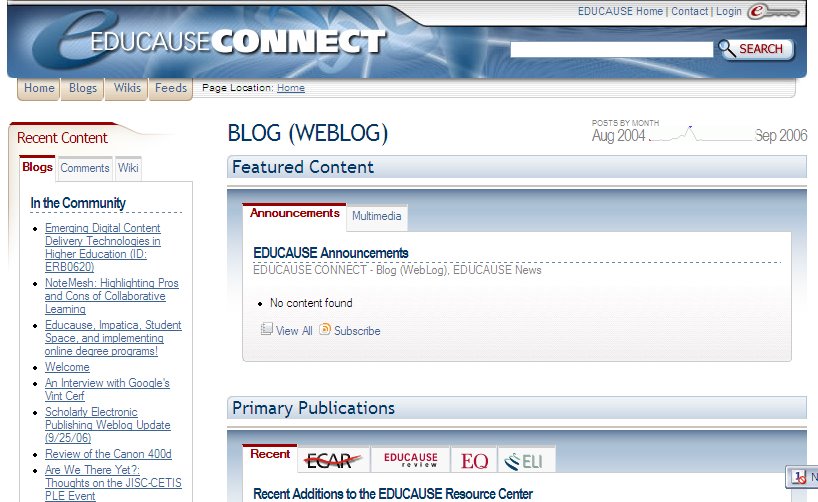
Educause Connect is a social networking website for people who are interested in all areas of technology in higher education. The site is organized by Tags (they seem to be pre-defined). The tag frequencies as of today were:
- Open Source (256)
- Blog (WebLog) (181)
- EDUCAUSE_ANNUAL (164)
- Teaching and Learning (159)
- E-Learning (95)
- Cybersecurity (94)
- OSS (Open Source Software) (93)
- Podcasting (68)
- Information Systems and Services (63)
- Policy and Law (59)
- Instructional Design (58)
- Social Software/Social Computing (57)
- Raves (55)
- Copyright / Intellectual Property Policies (53)
- CNI - Coalition for Networked Information (51)
- Rants (48)
- Events (47)
- Libraries and Technology (44)
- EDUCAUSE Conferences (41)
- Net Generation Learner (36)
- Intellectual Property Rights (34)
- Learning Space Design (33)
- Social Software (33)
- Blogs (32)
- Microsoft (30)
- Featured Content and Primary Publications - from several sources, both text and multimedia
- Community, including a Wiki, Educause-based Blogs that include the tag word, Jobs, Events, People
- Elsewhere on the Net, which has the same categories as Community, but lists information from outside of Educause
I stumbled upon this site through and email from the Educause national meeting that is coming up in October in Dallas, Texas. It looks relatively new, with almost none of the wikis having been started by anyone yet. And the site notes that it will be adding more resources in the future. Very worthwhile way of getting information, news and thoughts on your favorite new media applications in higher education. Check it out!
Langganan:
Postingan (Atom)