Cari Blog Ini

Tampilkan postingan dengan label Gangs. Tampilkan semua postingan

Rabu, 09 November 2011

Top Boy: DEBATE

I received this message via Facebook on the weekend…


TOP BOY DEBATE SHOW shall be taking place Tuesday 7pm at Veranda bar 30 Acre Lane, Brixton, London SW2 5SG, with Ashley Walters, Richard Campbell, Sharon Duncan Brewster, Mark Prince and Gifford Sutherland hosted By Karen Allen..

So last night I attended with fellow bloggers Janice and Lorraine Russell  .The event was organised by   Sherica Spence . I did not write an article about Top Boy, but I expressed my feelings clearly on Twitter. I commend anyone who is able to have an idea and manifest it into being, however I will always question the need for this particular type of drama to be shown if it appears to be solely for entertainment purposes. This is the counsellor and analyst within me. I am just not and have never been a passive viewer.

The writer Ronan Bennett wrote Top Boy through his observations whilst living in Hackney. The themes explored are real, the drama therefore is art imitating life and in my opinion this means the makers have a responsibility to provide a balance. The balance being that accompanying the drama, there should be a forum to discuss the themes within. Discussion can bring about new perspectives, which can provide new solutions and therefore change. The drama explores and comments on a few of many issues currently happening within society.

Author and Coach Karen Allen who has a company called  Mad Transformations was the host for the evening. It was left for her to reveal that none of the cast members listed would be attending. Fuming is an understatement. My gut told me this would be the case but I wanted to remain optimistic. I wanted to walk out because it always feels like the right people who need to hear things are never present to hear it. My fellow bloggers and the very nature of Karen Allen made me change my mind and I am glad they did.
Eight minutes into the debate and I was holding the mic. Top Boy clearly had a high budget evidenced through the marketing campaign on billboards, newspapers and television adverts. The production level of the drama was also high, evidenced through the amazing cinematography and helicopter shots. On the night the drama aired, cast members watched it at The Mayfair hotel and through the twitter hash tag monitored the responses. Cast and crew I'm sure have worked hard, so I am not knocking how they chose to celebrate. The monitoring of tweets was a great idea. 

However I was amazed that at the end of the drama a phone line number didn't appear like what you see in EastEnders when sensitive storylines are aired. The voiceover stated that more information on the themes can be found on the website, so off course I clicked and was greeted with a list of helpline numbers. For me it wasn't enough. The nature of the show would have brought up many different things for different people and a list of numbers felt like a barrier coupled with a relevant though basic requirement.

With a large budget to make and advertise the drama surely some money could have been put aside to create a more felt holding space? There was an interactive monitoring for the cast on the opening night but what about the public? Channel 4 could have asked the public to discuss certain themes revealed within each episode over the 4 nights via twitter and rather than Random Acts, which felt like a great way to expose new artists due to the level of viewers watching, how about a little3 min Wonder-esque piece from an ex-gang member, victim, father/mother? Reminding those watching that the drama just seen echo’s real life.
But "TopBoy depicts reality and these stories need to be told" were the voices of some yesterday. I will never condone any form of media that creates further discussion, thought or solution. The problem we have today is that people are forgetting that there is drama in reality everyday, though that appears to be too real so most would rather watch a drama imitating life and switch of and forget when the programme is finished. If everyone who watched Topboy watched The Hospital also aired on Channel 4, which I reviewed in article Road Blocked , we would all be in a better position.

When a drama such as Top Boy imitates what is happening in London right now, it is the responsibility of the maker to use it as a tool for discussion in the promotion of change, in my opinion. The fact that no one attended the discussion last night informs me this was not on their agenda. Nor was it on there agenda to reflect on the appropriateness of the positioning of the posters. On the way home from the event I was surprised to see they had a billboard in Peckham. I just don’t get it. 


As a result this feels like service to self. A hot topic used that will naturally bring in viewers, ratings and instant recognition to an already recognised writer. Service to others would have meant that this discussion would have taken place in City Hall or somewhere similar with MP’s, the mayor of London, the writer, channel 4 executives and the public. Everyone coming together to try and tackle the problem through hearing diverse voices and suggestions. This makes perfect sense to me especially as MP's Teresa May and Iain Duncan Smith recently said...
                                
"Rival gangs in Britain's inner cities use rape as a weapon"

"Gang members are like 'child soldiers"

However as I have said time and time again in numerous articles, no one is connecting the dots and following through to provide realistic solutions. Members of the Parliament should be changed to Members of the Public to reflect the diverse members of society. Those that work directly on the ground level need to be involved in decision making otherwise the quotes above will remain just that. 


This debate was highly emotive, valuable and needed. The contributions from all were insightful and respected, however it was the honest expressions from Mark Prince and Robyn Travis that gave me a lump in my throat and tears in my eyes. 
Mark Prince is the father of Kiyan Prince a talented footballer and so much more, who was murdered on May 18th 2006. Out of this tragedy Mark set up The Kiyan Prince Foundation (KYP) and has become an “accidental” figurehead and “Britain’s most high-profile spokesman in the fight against knife and gun crime in the United Kingdom”. His pain is felt but so is his love and passion to create change.
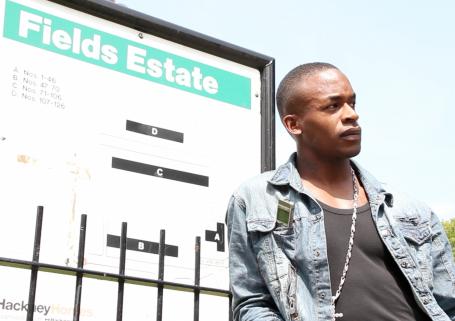
 
'Freedom from the Womb, Prisoner To The Streets' is the name of Robyn Travis’ soon to be released book which is based on his life growing up. Robyn is a Youth and Community Worker using his experiences to inform and prevent others from going down a similar path. Again I cannot do justice to what he expressed within this article. The experiences of both men are more harrowing than any drama I have seen. This is reality, this is real life and this is what is happening and effecting many people. Their voices need to be heard because it will penetrate the hardest of hearts whilst providing the way to solid solutions. 


Those from Top Boy who were meant to attend and didn’t, for whatever reason missed out. Those that didn’t get to attend due to the lack of notice and exposure, missed out because the same level of attention to the post drama wasn’t given. This event was organised last minute by Sherica Spence she said ...

“The point of the debate was for people to voice their opinions on the show but also to hear from those such as Mark Prince, Gifford Sutherland, Lisa Carr and Robyn Travis who are all actively doing out reach work in the community on what they hear and witness on a day to day basis. I wanted to leave people feeling inspired and wanting to make a change and a difference in their community”.

There are numerous outcomes as there are various paths. In order to see them, hear them and see the light at the end of the tunnel, we are the ones who have to voice them, write them and manifest them into reality and through various media mediums.

Related Posts:

Selasa, 04 Oktober 2011

Dot to Dot: Part 2

Black is...
Slavery was...
I am....
I was hesitate as I walked up the steps and into the International Slavery Museum. A mixture of dread and expectancy of the horrors that I was about to face, I know was the cause.  The sound of noisy school children broke my anxiety and replaced it with annoyance. My purpose for visiting the museum as explained in  Dot to Dot:Part 1, was to look at my historical past and so in a strange way it was almost like I was visiting the graves of my ancestors and this space was my moment to gather and process through quiet reflection which was now trampled on by carelessness, naivety and a lack of respect. It was difficult but I soon zoned the disruptions out and dropped the strong sense of seriousness that I was clearly carrying.
The dimly lit room quickly set the mood, heavy, thick, dense and oppressive. Each step was greeted with voices of the past through quotes carved into the walls. This one in particular stood out for me
How insightful? How true? How sad! I have only ever focused on their pain overlooking their courage.

The museum holds a wealth of information stemming from and explaining...
  • How Slavery began
  • The middle passage voyages
  • How slaves were treated
  • Who profited and the economic benefits of slavery
  • The impact of Africa
  • Global inequality and contemporary slavery
  • From the shores of Africa the influence of black music today
  • Exploration from various voices as to what it means to be Black British, African-American or of African decent in different parts of the world today. 
The photographs I am about to include are based on what resonated most with me, coupled with brief comments before expressing further thoughts and insights. 

My mouth hung open for sometime before making a few comparisons that are thoughts and questions  and ones that probably will remain that way.


If cellular memory exits and black people as  a collective have internalised Oppression than there must be an opposite for white people. I have heard of white privilege and white guilt but is there more within their unconsciousness? What is the conditioned behaviour and how would this be displayed due to their historical past in the present?
                                            
This weekend a friend posted to me Michael Moore's A brief history of The United States 
Interesting right? 


I cannot and will never be able to fully imagine what it must have felt like to be shackled.These shackles are from the Late 18th Century and were found in Tamale, Northern Ghana.


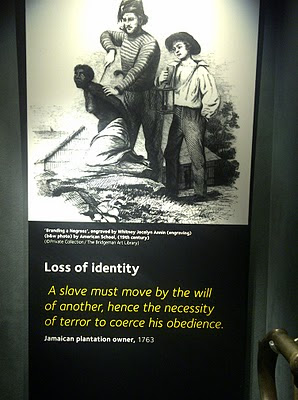
"Africans were branded with hot irons, no differently from cattle to mark them out as possessions.Plantation owners and slave traders alike justified their atrocious actions by claiming that black men, women and children were closer to animals than they were to white people." 

In regards to the branding of slaves, I have always wondered whether this has informed my dislike for tattoos. Perhaps I  simply just don't like them. 
"Sold, branded and issued with a new name, the enslaved Africans were separated and stripped of their identity". 

In the picture below you can see that their names had been replaced with English sounding names. On the fourth line down a man was given the name "Nobody". 
The sensory room is interestingly powerful. The sound of the waves and the quick glimpses of shackles and vomit successfully  conjure up the severe confined space, restriction and confusion. As I'm in there I remember the time I was sick on the ferry on the way to France. At the time I thought I was dying and just wanted the whole experience to end. Even if I multiply my encounter by 1000 I would still be no where near in successfully recreating the experience on a slave ship.


“A churnel stench, effluvium of loving death spreads outward form the hold, where the living and the dead, the horribly dying, lie interlocked, lie foul with blood and excrement”.  Robert Hayden, 1962
I sat in another room and listened to an African women tell the heart rending story of her children being captured and enslaved. This was the first time that I fully acknowledged the two way process of loss. Children and adults were removed from their families by force and entered into the unknown. The people left behind also entered into the same grieving process and uncertainty. The level of trauma to both sides is immeasurable and further heightened when friends, siblings and relatives who were taken together were sold and separated.  

As the risk of being taken was high, many equipped their children with knowledge in how to best survive. This makes sense but can you imagine the level of anxiety this must have caused in both the parent and child? They were prepared from an early age and I now see the residue from the past and into the future with “Your black and you have to work ten times harder than your white counterparts”. The line between preparation and conditioning appears to have merged into one to such a degree that I linger over the very real possibility that Black people expect hardship and learn to deal with it, get on with it. We have been expected to be strong and have been for centuries. “What wont kill you, will make you stronger.” I wonder where this saying came from?


The model of a plantation was informative.When you pressed the button certain areas would light up giving a visual description coupled with the written. The harsh realities of slavery gave mercy to no one, not even pregnant women. Their babies were important, they were future workers and so before punishment proceeded women were forced to lay face down, where a hole dug into the ground accommodated and supported their swollen bellies, before the reign of lashings commenced. We know the stresses of a mother can cause distress to an unborn child and so whilst physical harm did not occur, the damage had already been done. The mothers energy, emotional state is passed onto the child proving scars of slavery are both visual and psychological, whilst strengthening the notion of cellular memory that I raised in part 1

"Being regarded simply as property, devoid of any human rights, meant that enslaves Africans were exposed to the most ruthless abuse and crippling work load. Such atrocities went unchallenged because chattel slaves had no right to complain".  
'Chattel' is an old word for property.
"They  were divided into three work gangs. They were also divided against each other”.

This sentence stood out for me. In my earlier post  Road Blocked , I highlighted The LA Crips and The Bloods to help explain the ridiculous “postcode”/“turf” wars that are present in London today. However as a result of the above I believe the connected dots stem beyond American gangs and lead straight to the era of slavery. 

Self-hate and black on black crime; could this be a conditioned way of being as a result of slavery? If so this may partly explain why no young person can coherently and consciously explain why they do what they do.  I am not removing blame or condoning the actions of those who do wrong, I am trying to extend beyond the current suggestions that have led, in my eyes to the same place, a regurgitated dead end. Perpetrator and victim seems to be the stagnant back and forth line that leads to no where. For the first time I clearly see the meaning within the meaningless.  

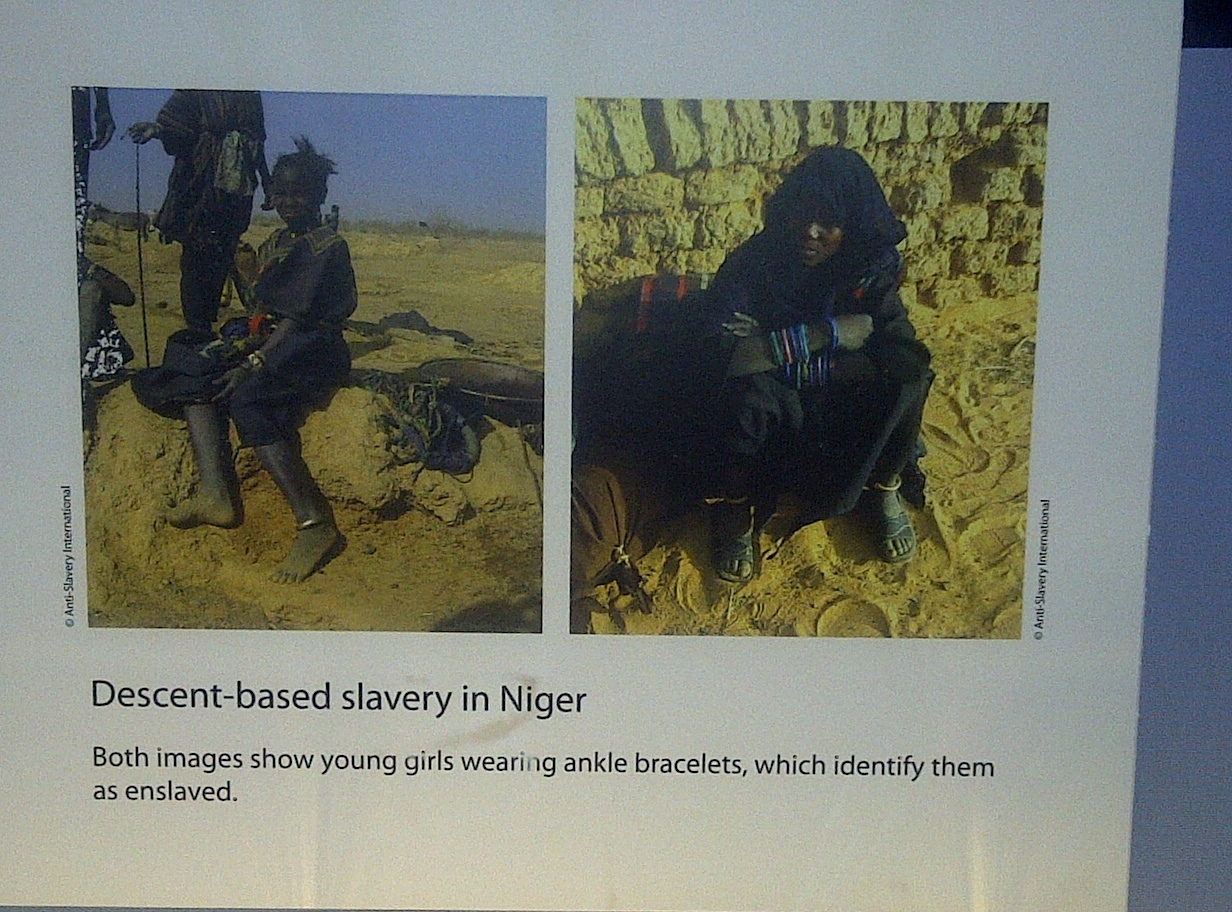
Slavery still exists in both visible and invisible shackles...

...though we rarely see the visible. However we know trafficking, exploitation and forced labour exits. As I entered further into the contemporary slavery section of the museum, I felt the list of what constitutes as modern slavery also needs to include Gangs.Why? The idea of an extended family originated from an honest, caring, helpful, community based place. However  though time to the present day I only see a unit that is based on targeting, grooming, initiation, bullying tactics from “elders” to “young uns” emeshed in fear, force, power and control, clocked in the illusion of togetherness, loyalty, protection and progression. As a result I agree with this quote 
"Slavery still exists. Indeed it is more diverse and entrenched than it was ever before." 
                            -Gloria Steinhem, 2006

We respect history in the forms of folklore, stories, quotes and antiques passed down from generation to generation. These are our ancestors external imprints, cellular memory and the known factors that are embedded within it, is our internal ancestors imprints. There are many questions that I still have, however connecting the dots in light of found information is enabling me to make some connections. Of course this is my subjective processing and therefore only an opinion, it is not fact however many arguments and even "facts" have been built on less information.

Although the past may well be in the past so much of the present appears to be informed by it, in ways that I hadn't before considered. Historians through finding physical evidence are able to built knowledge from an era that no longer exists. Hard and scientific evidence is given more value than the unseen, in spite of the knowledge in human behaviour through psychology and the acknowledgement that possibilities are vast and endless.  Slavery did take place and still takes place, though in different forms as we know, therefore my concept of gangs being a form of contemporary slavery is definitely out the box, but plausible and a new angle for further exploration. 

didn't know what I would gain from visiting the museum because dread didn't allow me to think any further, however the experience has been refreshing and enlightening. I would recommend everyone to visit this museum at some point to see and experience the history in full as it is presented.

...a strange metaphor to describe a group of people
...an inhumane event in history that has transcended to new meaning
...I am in the driving seat of my present and future because I am conscious of the impact of the unconscious.
EXTRA NOTES:

Gang members are like 'child soldiers' says iain Duncan smith see article here 

http://www.thisislondon.co.uk/standard/politics/article-23993914-iain-duncan-smith-gang-members-are-like-child-soldiers.do

Based on my above thoughts I would have to agree. However I wish politicians would learn to breakdown their statements to provide further meaning, as this alone sounds like a shock tactic emotive based sentence that restricts many from making the insightful contemporary comparisons. 


Related Posts:

© Lisa Bent 2011

Minggu, 15 Agustus 2010

Road Blocked


The Hospital, a channel 4 documentary which focused on knife crime in North London left me a tearful speechless wreck. Like the participants I struggled to understand why this was happening and how it all began and so I racked my brains until my head hurt.

We are all destined to die, if it happens it happens” these are the words of Daniel a 16 year old boy who was knifed in the heart and survived. He had multiple organ failure and within 6 weeks had received 9 operations. His words shocked me but he echoes the mentality of the majority of young boys today, which is disturbing as it cheapens the gift of life.

Whilst death is inevitable no one deserves to die with fear in their eyes and heart. A life cut short in this way is murder. The growing numbers of people who have died since the wave of knife crimes were not destined to die in this way, many hadn’t even lived. Life is precious and on the streets of London it is being taken away in a blink of an eye with the glint of a blade. For what? What are they fighting for?

Respect is a word banded about so much that it has now lost its meaning, they are doing everything but respecting people, others and themselves. Plus this talk of post code turf war is absolutely absurd. These boys, young men, in gangs are killing each other because others have dared to enter into a place where they reside, which they must fight for and protect. Erm... what are they protecting exactly? London is so small you could be on a road that is one postcode one minute, turn left and be in another area the next.

It’s like something out of a wild life documentary by David Attenborough who observes that the un-expecting prey is pounced upon by a pack of lions, as it dared to enter their domain. But this is people we are talking about. Are we not meant to be more intelligent as we have a conscious, a higher sense of reasoning and a life that extends beyond day to day survival? For some evidently not made clear by Taurean, a 22 year old stabbed in a fight who gave a personal insight into what is happening in his area, the result being “Hackney is the centre of my universe.”

At this point I was incensed with anger, Martin Luther King, Malcolm X and Rosa Parks, to name a few fought so hard to allow us to have greater freedom and right now, black boys feel trapped by numbers, letters, concrete and fear. We have gone backwards and I feel while they are turning in their graves, the BNP and Klu Clux Clan have their feet up with smiles on their faces.

Asked to shed light on why this is happening Taurean is just as baffled. If those directly involved or affected by this nonsense can’t explain why they are doing it, or why it is occurring then how can we as adults, provide help and guidance? So many bleat about how hard done by in life they are, yet they are the ones who have created these rules which have now become both their mental and physical prisons. Or have they? To understand this postcode restriction and random attacks, which is gang related, looking back to southern Los Angeles street gangs, the Crips and Bloods seems naively obvious.

These two violent street gangs began in 1969 between predominately African-Americans and Hispanics, both active and highly successful in the drug trade. New members were recruited by their environment, which were predominately poor African-American communities often of school age. Gang membership offered a sense of belonging, protection and immediate gratification to the economically disadvantaged youth, who equated gang life to gold Jewellery, cash, nice cars and expensive sports clothes.

The Crips adopted the colour blue for their clothing and Bloods red to identify and differentiate themselves. "Cuzz," short for cousin was the greeting term adopted by the Crips in greeting each other, whilst the Bloods used “Blood” as a symbol for their gang family. All gang members were identified by a nickname, AKA or street name, which usually gave an insight into their psychological perspective of themselves.

There are evidently clear similarities with gangs in the UK! Fascinated by American culture perhaps this is where all this stems from. From as early as I can remember it was said that Britain was 10 years behind America. Well it is now on our doorstep in all its self-fulfilling prophecy glory. As gangs in America are supposedly dying out, it is rapidly growing here. Apparently there are 36 gangs operating in the borough of Lambeth alone!

The senseless killings are about gaining “stripes” projecting a “bad man” exterior coupled with “I’ll get you before you get me” This is not a spaghetti film or a music video. There is no director that will shout “cut” signalling them to wake up from their collapsed position and wipe away the fake blood. Unfortunately the reality may come too late for some. A young decision, an action or reaction can have lifetime consequences.


Whilst emulation has occurred due to the glorification of gang life in films and music, I am still left contemplating as to whether there are more reasons. What is it that makes an experience elsewhere, resonate so much here? Is it identification with wanting more? The socio-political unbalance? Or the immediate identification with people who are of the same colour? I came across a trailer called Crips and Blood: Made in America, a documentary narrated by Academy Award winner Forest Whitaker, revealing the modern-day gang life: the turf wars and territorialism, the inter-gang hierarchy, rules of behaviour, the culture of guns, death and dishonour. Within the 2 minutes 46 seconds, a respondent revealed that the Crips formed as a result of frustration and anger as a result of racism, discrimination and injustice: 

I thought further and remembered a quote by Alice Walker who said Men make war to get attention. All killing is an expression of self-hate”. This notion of self hate coupled with the knowledge of racism and Internalized Oppression, a term coined by Black Psychologist Frantz Fanon which highlights the ongoing impact slavery; imperialism and colonisation have on the psychical levels, should be considered together for further exploration (I will attempt this in a future article). For now I ponder whether this is the frustrated powerless exercising what they deem to be power and control?

As Daniel looked at his family around him he broke down. Although he didn’t say much, the pain and fear in his eyes spoke volumes; he looked like a scared lost deer which was a horrible sight that triggered my tears to flow. The reality of what he had been through, the love and worry of his family surrounding him and the new and very real struggle back to recovery seemed to hit home in that one moment. Daniel upon facing death was glad and grateful to be alive and the hard words expressed earlier revealed themselves to be fake bravado, empty, selfish and valueless.

As well as the physical injuries Daniel and so many other survivors of knife crime and crime in general, must now also strive to overcome the psychological damage which is just as crippling. Post Traumatic Stress Disorder (PTSD) is common amongst anyone who has been in a life threatening situation. PSTD is likely if the person has been exposed to a traumatic event in which both of the following were present:
“The person experienced, witnessed or was confronted with an event or events that involved actual or threatened death or serious injury, or a threat to the physical integrity of self or others. The person’s response involved intense fear, helplessness, or horror” (Scott et al., 1995, p.78).

Direct related signs of PTSD will include heart palpitations, anxiousness, distressing dreams; unpleasant and intrusive thoughts, disruptions of behaviour, fatigue, insomnia, irritability, and a return of fear. PTSD was first documented amongst war veterans but is now also associated with experiences such as child sexual abuse, rape, terrorist bombings, vehicle accidents, physical or emotional abuse and natural disasters such as earthquakes. The meaning and order of the world for survivors crumbles beneath them. Their sense of self worth, safety, stability and sense of control is compromised and shattered. Cognitive Behavioural Therapy (CBT) is considered to be the appropriate intervention for PTSD.

At this point my mind crossed over to the perpetrator. Yes, he plunged the knife in cold blood with no conscience or respect for life and ran off, not sticking around to hear the sirens and the chaos thereafter. So why should I, we care? The perpetrator would have smelt the fear, his own and his victims. Seen the blood, his own and/or his victims and as their eyes met in this surreal but very real situation of aggression, fake bravado and survival, will too have seen the mirrored truth, which he knows and feels in the reflected eyes of the other, FEAR!
As the perpetrator, the cause, but also the witness, PSTD is likely and I wonder how he deals with the memories at night and in the day? The psychological distress must be high as the potentiality of a mental health disorder. Two birds are killed with one stone. The perpetrator and victim are both scarred. There are no winners here!

The Hospital series is an eye opener as it directly voices the opinions of the issues that affect young people, giving an insight into their world view. Whilst my emotions and frustrations dipped and dived throughout, I acknowledge that this is what they are going through. This is what they know, all they know. This is what they are dealing with and they cannot see bigger or beyond the end of their road due to fear, attack and tunnel vision. So what do we do about it? What happens next? After all, we are the adults who can see that Hackney is not the centre of the universe.

Gangs and post code wars were perhaps structures built on top of the foundations of fear, pain, frustration and powerlessness, however these structures only serve to be visual, mental and physical road blocks to potential, self development and a future.

The reality of the situation needs to hit home to these youngsters and fast. Prisoners and reformed gang members need to directly show the way, as whilst this series is absolutely brilliant, I am convinced that those who needed to watch it for a wake up call, were out on the street...defending their area!

©2010 Lisa Bent